
St. Louis County Arrest News Sources
For official word on local incidents, start with the Duluth Police Department press-release archive. Releases there are dated and cover selected incidents, investigations, missing-person cases, and some arrests. A release may name the St. Louis County Jail as a booking destination. What it will not give you is a daily list of everyone arrested. The archive is event-driven, so names appear only when the agency chooses to publicize something, and a photo is never guaranteed for each person or event.
The county's official social-media directory lists Sheriff channels that carry public-safety notices, service updates, investigations, and events. These posts are handy when you want an agency's statement quickly. Just know their limits: they are not a booking database, not an arrest log, and not a full picture of county police activity. No official St. Louis County booking-photo app exists.
St. Louis County News Outlets
News stories add narrative detail that rosters lack. A good report may name the arresting agency, the date, or a court event. Treat it as a lead, not as the source record. The table lists official channels first, then regional coverage. Read any story photo with care: check the caption and credit, since an image can be contributed, agency-supplied, or unrelated to the actual booking photo.
| Outlet | Coverage | Photos? | Where to use it |
|---|---|---|---|
| Duluth Police releases | Dated official incident and arrest-related releases | Only when an individual release includes one | Agency context and selected incident facts |
| St. Louis County Sheriff channels | Public information, investigations, services, and events | Not a verified booking collection | Agency notices, not a custody search |
| Duluth News Tribune local news | Regional local, crime, and court reporting | Story-specific and source-dependent | Incident lead and later local context |
| DNT Matters of Record | Recurring courthouse and public-record digest | Not a roster or photo feed | Later court and disposition context |
| Northern News Now crime | Duluth-area arrest, warrant, shooting, and court stories | Not consistently booking photos | Event-driven regional reporting |
Two regional outlets do most of the local crime coverage. The Duluth News Tribune local section and Northern News Now crime page both publish St. Louis County arrest stories. Neither comes close to a full arrest roster. After an arrest, DNT's Matters of Record is worth a look for courthouse context. Even so, it cannot replace a court file or a current custody record.
Duluth Police Arrest Releases
Think of the Duluth archive as selective public information. Its releases stretch across years. They show the agency's own account of major incidents. Someone missing from the list may still have been arrested, cited, released, or booked somewhere else. A name in a release tells you nothing about how a case later turned out. For custody questions, the county roster is the next record to check. The Duluth Busted Mugshots path adds city-specific police and booking context.
The Duluth Police press-release archive offers a dated release list plus a search interface.
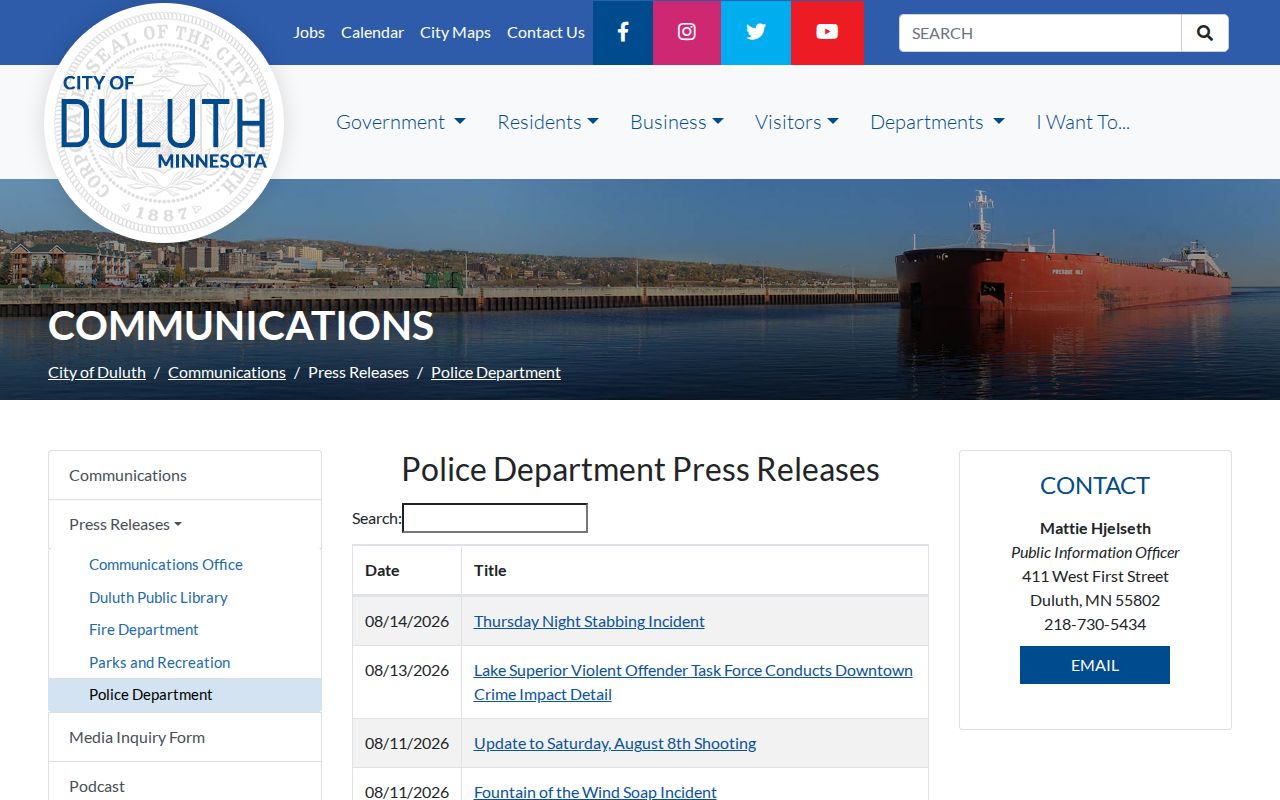
The archive is an incident-news source, plain and simple. It is not a county booking roster. It also does not reproduce every arrest or booking photograph.
Story to St. Louis County Record
A story gives you the starting facts for a records search. Write down the story date and the arresting agency. Note the exact name spelling and any booking or case number. Then keep news reporting separate from custody and court records. The county-wide booking and roster reference covers each source in more depth.
- Read the story's date and identify the agency. Do not infer a booking from an incident report, because a person can be cited, released, transferred, or still in intake.
- Search the current St. Louis County Jail Roster for the name. Compare the booking number, booking date, arresting agency, charge, bail, and projected release fields before drawing a match.
- Check the county's 48-hour release roster if the person is not on the current list. A recent release is a custody change, not a court disposition.
- Request an existing booking record or photograph from the Sheriff Records Division when the roster identifies a county booking. Ask for the record by name, date, booking number, and arresting agency.
- Use the court file to distinguish the arrest-stage record from later proceedings. A filed complaint, dismissal, conviction, or sentence is a separate event that must be supported by the correct case record.
Note: The official current roster updates hourly, though the county warns that people in intake may not appear until a booking number is assigned.
St. Louis County Booking Feed Limits
St. Louis County has no separate official same-day booking feed. The fallback is the current jail roster. The county says it updates hourly. Even that is not a complete daily arrest list, because a person can sit in transport or intake before a booking number exists. Someone cited or released may never enter the county jail at all. Duluth police releases are selective news reports, not a substitute for the custody record.
The 48-hour roster is a release product. It is not a booking feed. It can explain why someone vanished from the current roster, but it cannot tell you how a case ended. There is no official weekly booking archive either. Third-party mirror pages are leads at best. Let the live roster, a records request, and the court file settle any conflict over dates or claims.
A current roster entry carries real substance. Booking number, booking date and time, arresting agency, location, bail, charge description, offense level, order type, and projected release information are all there. Those fields beat a headline for verifying a news report. The roster does not display a booking photo. Request one from the responsible records custodian rather than assuming it is online.
St. Louis County News Photo Sources
Where did the picture come from? That question matters more than the picture itself. News photos can arrive as agency handouts, jail-supplied images, staff shots, or credited third-party work. Duluth News Tribune crime coverage has at times used photographs from the St. Louis County Jail. The paper does not maintain a verified mugshot gallery. A caption, credit, and story date tell you more than the image does, so keep them attached to whatever you save.
The legal frame comes from Minnesota Statutes section 13.82. That statute governs adult law-enforcement data and defines a booking photo as an identification image taken at an arrest. Public access can still shrink when identities are protected or an active investigation calls for temporary withholding. Notably, the statute requires no agency to create or keep an image. A news photograph is not a custody record.
For a sense of how one outlet handles this beat, the DNT Matters of Record source shows the paper's court-focused public-record coverage.
Matters of Record can point you toward later court context. That is its real value. It will not show booking photos, though. It is not a live jail roster, and it does not replace the official case file.
St. Louis County Court Status
Once an arrest shows up in the news or on a roster, the official path for case information is Minnesota Court Records Online. St. Louis County sits in the Sixth Judicial District. Courthouses in Duluth, Hibbing, and Virginia each handle part of the caseload. Search with the strongest identifier the official record gives you: a case number, citation, attorney name, filing date, or court location.
Name searches have a real limit. MCRO does not return pending criminal matters by defendant name until conviction, so an empty result proves nothing about whether a case exists. A citation number, a courthouse public terminal, or a call to court administration will get you further. Remember that online results are not certified records. The County Attorney's criminal prosecution page lays out the prosecution role, but it is not a booking or case-search tool.
Court cases move through distinct stages. Release, complaint, dismissal, plea, conviction, acquittal, diversion, a stay, and a sentence are separate events. Carry the court record's own language forward rather than repeating a headline or booking charge as if it were the outcome.
St. Louis County Third-Party Limits
Unofficial sites should never outrank the county roster, an agency release, a records request, or the court file. Several third-party pages touch on St. Louis County: a historical listing at Mugshots.com, a Minnesota Arrests page with unclear mugshot coverage, an archive-style Jailrosters.org entry, the unofficial slcjailroster.com mirror, and a MinnesotaJailRoster directory. None is official. Any of them can be stale or stripped of context, so check everything against the county source.
Busted Newspaper, RecentlyBooked, and Mugshots.zone did not surface a verified St. Louis County section. A guessed local page is not coverage. Start with the arresting agency and the county roster for a current report, then let the court record speak to how the case turned out. A mirror or historic index cannot tell you who is in custody now or how a charge resolved.